My dissertation was an investigation on how lexicons perform on sentiment classification of film reviews - this work was later expanded and incorporated into a chapter on the book "Knowledge Discovery Practices and Applications in Data Mining - Trends and New Domains".
A shorter version of this research was presented in Dublin's IT&T 2009 and available here.
The lexicon used here was SentiWordNet. Built from WordNet, SentiWordNet leverages WordNet's semantic relationships like synonyms and antonyms, and term glosses to expand a set of seeded words into a much larger lexicon. It can be tried online here. (also see Esuli and Sebastiani's SentiWordNet paper).
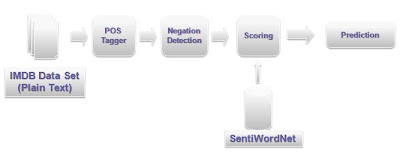
Using SeniWordNet for sentiment classification involves scanning a document for relevant terms and matching available information from the lexicon according to part of speech. There are some interesting NLP challenges involved here: we run the text via a part of speech tagger first to obtain details on whether terms are adjective, verb, etc. Then negation detection is performed to identify parts of text affected by a negating statement (ex: "not good" as opposed to "good"). Then, the document is scored based on terms found and whether it is negated. The overall approach is given below.
Resources
- Negation Detection - The NegEx algorithm from Chapman et al.
- The NLTK Python library has implementations of various part of speech taggers.
- The Stanford POS Tagger is a Java app implementing the method described here.

