Showing posts with label lexicons. Show all posts

Saturday, April 6, 2013

Online Tools for Sentiment Classification - Part II: The AIRC Sentiment Analyzer

The DIT AI Research Center (AIRC) Sentiment Analyzer is a web interface demonstrating some of our Sentiment Analysis research. It is available on:

http://airc-sentiment.org/

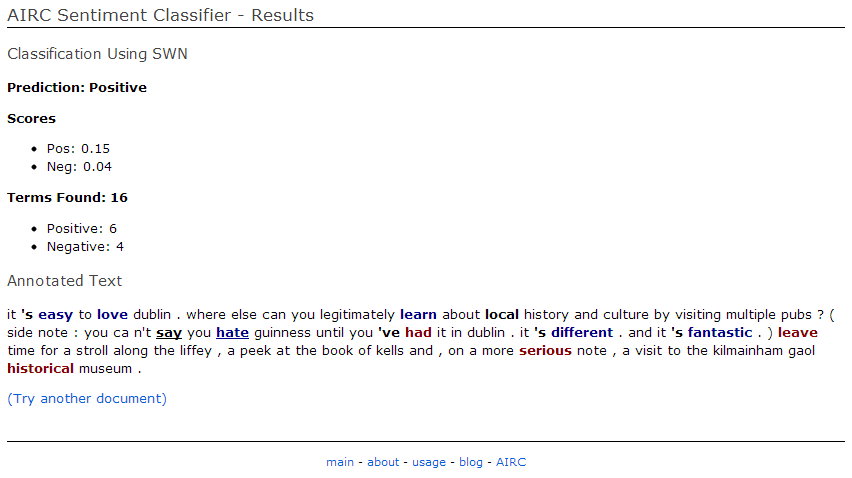
The Analyzer classifies sentiment of text input using a lexicon-based classifier (discussed in an earlier post here), allowing for some tuning of parameters so you can test different behaviors: users can select which part-of-speech tags to use, lexicon and enable/disable negation detection.

The work is based upon our research presented on:
Ohana, Bruno, Brendan Tierney, and S. Delany. "Domain Independent Sentiment Classification with Many Lexicons." Advanced Information Networking and Applications (WAINA), 2011 IEEE Workshops of International Conference on. IEEE, 2011. (PDF)

Wednesday, February 2, 2011

Sentiment Classification and Opinion Lexicons


Lexicons are a big part of my current research in opinion mining. Aside from the potential of helping supervised learning methods, they can be applied to unsupervised techniques - an appealing idea for research whose goal is domain independence. An opinion lexicon is a database that associates terms with opinion information - normally in the form of a numeric score indicating a term's positive or negative bias.

My dissertation was an investigation on how lexicons perform on sentiment classification of film reviews - this work was later expanded and incorporated into a chapter on the book "Knowledge Discovery Practices and Applications in Data Mining - Trends and New Domains".
A shorter version of this research was presented in Dublin's IT&T 2009 and available here.

The lexicon used here was SentiWordNet. Built from WordNet, SentiWordNet leverages WordNet's semantic relationships like synonyms and antonyms, and term glosses to expand a set of seeded words into a much larger lexicon. It can be tried online here. (also see Esuli and Sebastiani's SentiWordNet paper).

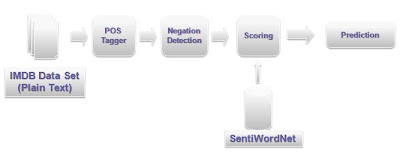
Using SeniWordNet for sentiment classification involves scanning a document for relevant terms and matching available information from the lexicon according to part of speech. There are some interesting NLP challenges involved here: we run the text via a part of speech tagger first to obtain details on whether terms are adjective, verb, etc. Then negation detection is performed to identify parts of text affected by a negating statement (ex: "not good" as opposed to "good"). Then, the document is scored based on terms found and whether it is negated. The overall approach is given below.


Resources